I study electrical engineering, and I am working toward quantum mechanics. This notebook is where the physics I learn gets derived, computed and checked in public, including the parts I don’t understand yet.
Where I am
Engineering student. Physics so far: calculus, probability and statistics, electromagnetic fields, materials science.
Where it goes
Quantum mechanics, then research. Ten entries so far; the eleventh is the quantum oscillator.
No. 018 October 2025. Materials science, homework one, written with a classmate
Hooke’s law is the second term of a Taylor series
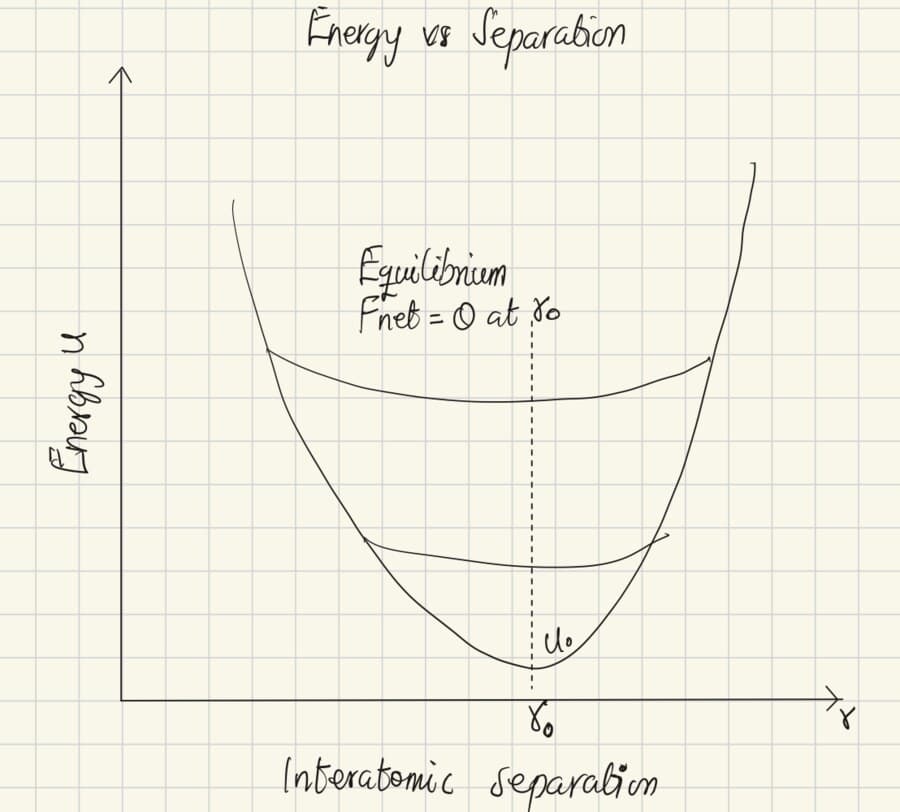
My sketch for the assignment: energy against separation, with the minimum at r0.
Stretch the bond. Near r0 the parabola and the bond agree; away from it they part, and the shaded gap is the error. The curve is a Morse potential, chosen for this figure. Drag the handle.
At the bottom of any smooth well the force is zero, so the first derivative vanishes and the Taylor series of the energy starts at the square term. Differentiate once more and you have a spring. Linear elasticity is this parabola, seen from far away.
U(r) ≈ U(r0) + ½ k (r − r0)²⇒F(r) = −dU/dr ≈ −k (r − r0)
what I don’t understand yet
How the stiffness k of one bond becomes the Young’s modulus a testing machine reports. My Strain tool fits E below 0.25 % strain; deriving the bridge from k to E comes next.
where this goes
In quantum mechanics this parabola is the harmonic oscillator, and its energy comes in steps: En = ħω(n + ½). That is entry 11, not written yet.
No. 0922 February 2026. Probability and statistics, MT2204. Code on GitHub.
A message is an interval: arithmetic coding
Arithmetic coding gives every symbol a slice of [0, 1) as wide as its probability, zooms into the slice, and repeats. The seven letters of my name leave an interval about five millionths wide. Naming one number inside it takes 18 bits. The entropy of the letters says 17.65 bits is the floor.
Encoding DESMOND with symbol counts taken from the message itself, the fixed model my encoder uses. Each row zooms into the highlighted slice of the row above. Computed on this page.
what I don’t understand yet
My encoder holds the interval as a 28-digit decimal, and it collapses after a few dozen symbols. Real coders use integers and renormalise as they go. I want to derive why that loses nothing.